

'Ghost particles' from space telescope wins physics Nobel
Belgian physicist Prof Francis Halzen has won for his pioneering work on an observatory that detects particles from space.
REALNEWS HUB Newsroom
Oct 6, 2026, 16:26 UTC
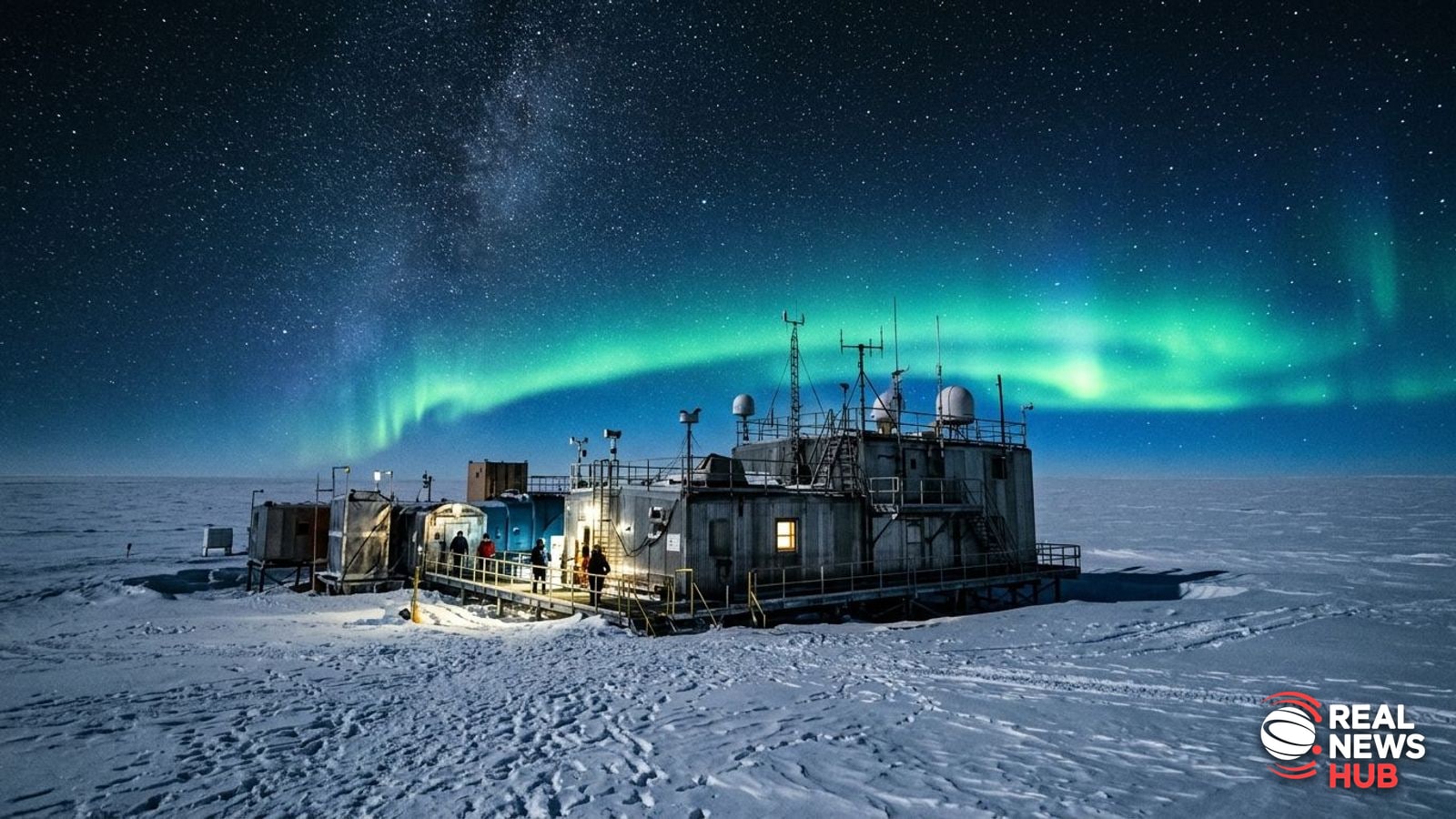
Belgian-born physicist Francis Halzen has been awarded the Nobel Prize in Physics for his foundational contributions to an Antarctic observatory that tracks high-energy particles traveling from deep space, the Royal Swedish Academy of Sciences announced.
Halzen, a professor at the University of Wisconsin–Madison who holds American citizenship, spearheaded the creation of the IceCube Neutrino Observatory located at the geographic South Pole. The facility transforms a cubic kilometer of pristine polar ice into an enormous detector, capturing information about extreme astrophysical events across the universe.
The Nobel committee credited the researcher with playing a decisive role through his guidance and foresight. Mark Pearce, who chairs the physics selection panel, remarked that Halzen’s leadership of an international engineering and scientific team had delivered a remarkable apparatus, adding that his determination helped initiate a fresh era of astronomical research.
Initially proposed by Halzen in 1988, the project was considered a long shot by many in the field. Reflecting on the accomplishment during a press conference, the laureate admitted he had felt fortunate, noting that when the concept was first introduced, widespread skepticism existed regarding whether such a detector could succeed.
Neutrinos are subatomic particles that possess no electrical charge and virtually never collide with normal matter. While billions generated by the Sun pass through everyday objects every second without impact, IceCube focuses on much more energetic specimens created outside the solar system by catastrophic cosmological phenomena. Because magnetic fields cannot alter their trajectory and matter does not stop them, they travel in direct paths from their cosmic birthplaces, functioning as cosmic messengers.
To capture these elusive particles, engineers lowered cables carrying thousands of optical sensors into boreholes deep within the Antarctic ice cap. When a rare neutrino directly strikes an atomic nucleus inside the ice, it generates secondary charged particles that emit faint blue light. The subterranean sensor grid tracks the intensity and arrival times of these flashes, enabling astronomers to reconstruct the original path and determine the cosmic origins of the particles.
Researchers use this data to study astronomical environments that standard optical and radio instruments cannot penetrate, including supermassive black holes and supernova explosions. Louis Barson, director of science at the Institute of Physics in London, noted that the South Pole installation has allowed researchers to examine events beyond the reach of traditional telescopes, attributing those breakthroughs to Halzen's foundational leadership.
Source & verification
VerifiedReported from Science.
Get breaking news alerts and the Morning Briefing
Verified stories in your inbox, every one linked to its sources. All newsletters →