

Chemistry Nobel awarded for solving mystery of life's asymmetry
The prize was given to the French and Japanese scientists for solving the mystery of life's asymmetry.
REALNEWS HUB Newsroom
Oct 7, 2026, 15:12 UTC
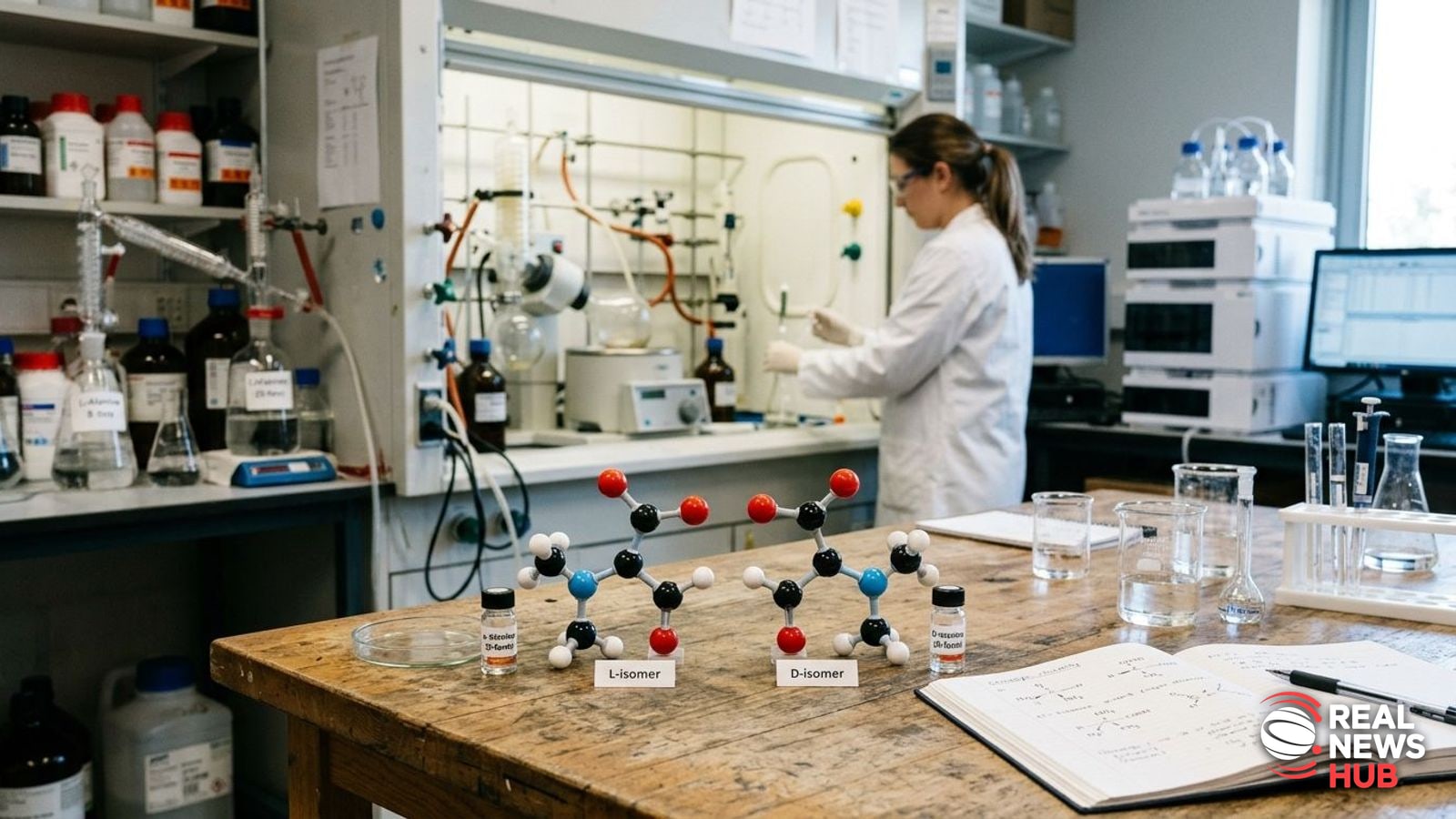
French researcher Henri B. Kagan and Japanese scientist Kenso Soai have been awarded the Nobel Prize in Chemistry for solving a long-standing mystery regarding life's molecular asymmetry, the Nobel Committee announced on Wednesday.
The laureates uncovered mechanisms explaining why biological systems rely almost entirely on a single structural orientation of certain molecules, rather than an even balance of mirror images. In organic chemistry, this trait is known as chirality, where molecules resemble human hands by existing in non-identical left- and right-handed configurations. While living organisms consistently use only one orientation—such as specific configurations of amino acids—synthetic chemical processes in laboratories traditionally yield an equal split between both forms.
The prize-winning discoveries hold major significance for pharmaceuticals, where mirror-image molecules can produce radically contrasting biological responses. In some cases, one version of a compound acts therapeutically while its counterpart is ineffective or toxic. A prominent historical case was thalidomide, a morning-sickness medicine distributed during the 1950s that caused severe birth defects across thousands of children because its opposing molecular form was harmful.
Kagan, affiliated with Université Paris-Sud, advanced the field in 1986 by formulating a method to control chemical processes and generate a far higher proportion of a preferred mirror-image molecule than previously considered viable. Building on this foundation in 1995, Soai of the Tokyo University of Science revealed a process capable of achieving complete structural uniformity, or homochirality. By 2003, Soai succeeded in directing a chemical reaction to yield exclusively one intended orientation, a milestone the Nobel Committee noted had never before been achieved outside of living systems.
Heiner Linke, who chairs the Nobel Committee for Chemistry, praised the duo for untangling an issue that had puzzled scientists for more than a century by demonstrating how selective molecular production can arise spontaneously. Committee member Peter Somfai remarked that the breakthrough replicated in a laboratory setting a fundamental phenomenon that originated four billion years ago during the dawn of life.
Reacting to the honor during a telephone press conference, Soai described the announcement as one of the most exciting days of his life and recognized the broader community of scientists working on chiral chemistry.
Academic experts also highlighted the broader implications of the findings. Professor Robert Mokaya, president of the Royal Society of Chemistry, emphasized how foundational chemistry enables critical medical therapies by targeting specific molecular variants. University of Nottingham researcher Angus Davison noted that understanding molecular handedness provides key insights into physical asymmetry throughout biology, ranging from the placement of human internal organs to the spiral direction of snail shells.
The two researchers will share a financial reward of 12 million Swedish kronor, equivalent to approximately 1.25 million dollars, alongside the Nobel medals.
Source & verification
VerifiedReported from Science.
Get breaking news alerts and the Morning Briefing
Verified stories in your inbox, every one linked to its sources. All newsletters →