

Explained
Why has fighting flared up again in Yemen?
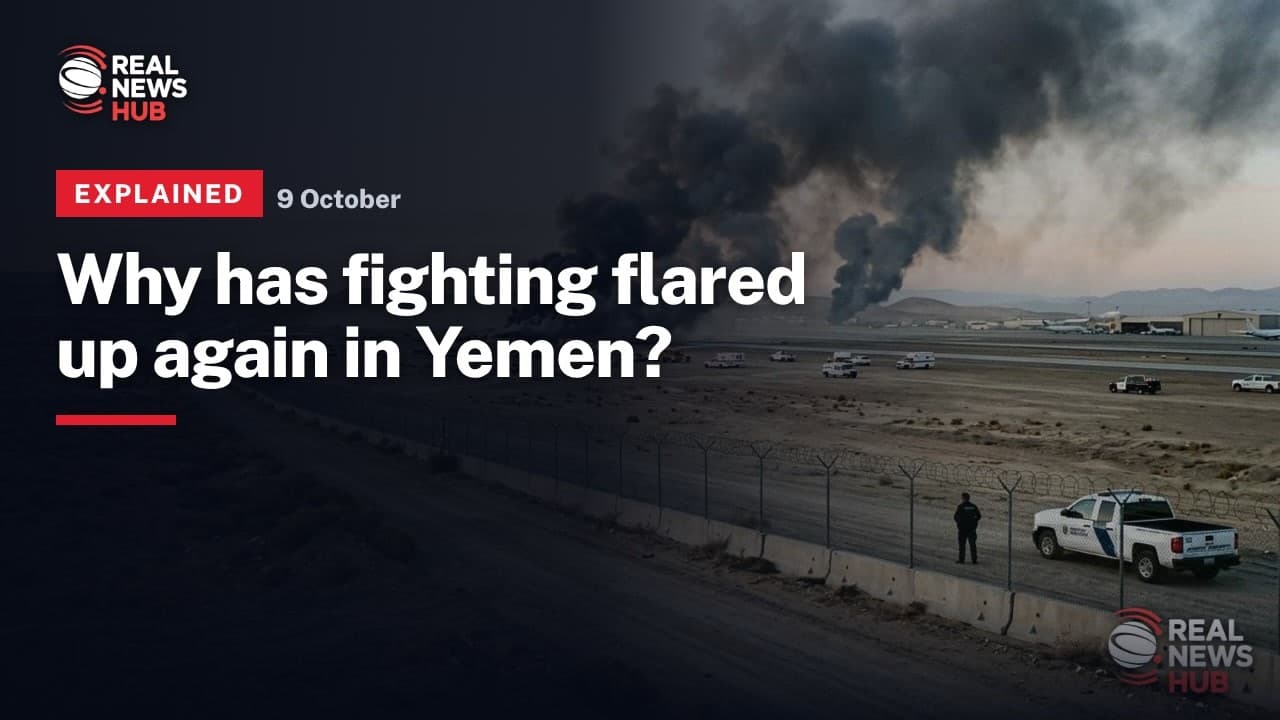
A fragile four-year truce in Yemen has collapsed into widespread warfare after rebel advances prompted the Saudi-backed government to launch Operation Yemen Dawn.

Watch: Explained in 3 minutes
The REALNEWS HUB Explained video · Watch on YouTube
Key facts
- An informal four-year truce broke down after July 2026.
- President Rashad al-Alimi launched Operation Yemen Dawn to retake all rebel territory.
- Pro-government forces claim to have secured the Bab al-Mandab Strait.
- Houthi cross-border attacks targeted Saudi Aramco facilities and Riyadh.
- At least 959 people have died and 197,000 have been displaced since August 6.
What triggered the renewed conflict?
An informal ceasefire that held for roughly four years broke down following actions in July 2026, when Houthi forces declared an embargo on Saudi maritime traffic and resumed long-range assaults on Saudi infrastructure. By September, rebel fighters mounted an offensive across southwestern Yemen, seizing territory along the Red Sea coast, taking over Dhubab, Mokha, and Perim Island, and severing the main highway linking Taiz to Aden.
In reaction to these losses, Rashad al-Alimi, head of Yemen's Presidential Leadership Council, announced a nationwide offensive called Operation Yemen Dawn from Riyadh on October 4. Alimi stated that diplomatic de-escalation efforts had failed and ordered allied forces to recapture all territory held by the rebel movement, including the capital, Sanaa.
Where is the ground fighting focused?
Backed by Saudi air cover, combined ground units including the Giants Brigades, the National Shield, and the Tihama Resistance mounted counteroffensives along the Red Sea coast. Government commanders announced they had secured the strategic Bab al-Mandab Strait, encircled rebel fighters in Dhubab, and taken the local airfield. Conflicting reports noted troops had reached the outskirts of Mokha as Houthi combatants withdrew, though Houthi media denied losing ground in Dhubab.
Concurrently, heavy combat flared across Taiz province. Houthi forces captured the al-Safiya district and cut transit lines to Aden, isolating Taiz. More than 70 fighters died in a single day of clashes around Taiz and neighboring Lahj province. Clashes and coalition aerial bombardments have also struck Saada, al-Jawf, and Sanaa.
How has the conflict spilled beyond Yemen's borders?
The fighting quickly expanded across national boundaries. Houthi forces claimed strikes using ballistic missiles and drones against Saudi Aramco facilities in Riyadh and Khurais, causing large fires verified by satellite imagery. On October 7, Saudi air defenses destroyed a ballistic missile north of Riyadh. The Saudi coalition also accused the Houthis of an uncrewed aerial strike on September 29 against an electrical substation in Medina, an allegation the rebel group denied.
Inside Yemen, two Houthi missiles struck near Aden International Airport on October 7, though no casualties were reported. A rebel coordination body also warned international airlines that the majority of Saudi airspace is dangerous.
What is the humanitarian and economic toll?
The renewed combat has inflicted heavy losses on civilians. The Yemeni health ministry reported that at least 959 people died and around 5,000 sustained injuries between August 6 and early October. United Nations data indicates that the violence has displaced approximately 197,000 individuals from their homes.
Global energy markets have also felt the effects of coastal fighting and threats to maritime shipping corridors near the Bab al-Mandab Strait and the Strait of Hormuz, causing international crude benchmarks to rise.
Timeline
- 2026-07An informal four-year truce breaks down following Houthi maritime embargo declarations and infrastructure strikes.
- Aug 6, 2026Heavy casualties and displacement begin mounting across active combat fronts.
- Sep 29, 2026A drone damages an electrical substation in Medina; the Saudi-led coalition blames the Houthis, who deny responsibility.
- Oct 4, 2026President Rashad al-Alimi announces a comprehensive military drive to retake all Houthi-held areas.
- Oct 5, 2026Pro-government forces announce the capture of key positions around the Bab al-Mandab Strait.
- Oct 7, 2026Missiles strike near Aden International Airport, and Saudi defenses intercept a missile over Riyadh.
What happens next?
Pro-government forces plan to continue operations until all Houthi-held territory is recaptured, while rebel authorities have warned commercial airlines that most Saudi airspace is no longer safe.
This explainer was written with AI assistance from REALNEWS HUB's own reporting listed below, and reviewed before publication. How we use AI
Spotted an error? Report it · Editorial standards · Corrections policy
Sources on REALNEWS HUB
- Middle East live: Houthis target airport in Yemen as Israel marks October 7 anniversary · Oct 7, 2026 · via France 24 Middle East
- Yemeni military says it has 'secured' Red Sea waterway · Oct 6, 2026 · via BBC News
- Yemeni government forces say they have 'secured' Bab al-Mandab Strait · Oct 5, 2026 · via BBC Middle East
- Yemen military announces broad range of strikes against Houthis in bid to retake lost territory · Oct 5, 2026 · via France 24 Middle East
- Yemen’s Saudi-backed government launches military drive to retake all Houthi-held territory · Oct 5, 2026 · via Guardian World
- Yemen's government announces all-out war to reclaim land from Houthis · Oct 4, 2026 · via BBC News
- Yemen announces military campaign to reclaim land from Iran-backed Houthis · Oct 4, 2026 · via BBC News
- Saudi-led coalition accuses Houthis of striking Medina power station · Oct 2, 2026 · via France 24 Middle East