

Explained
Why are Yemen's Houthis targeting Riyadh's airport?
A series of Houthi missile and drone strikes against King Khalid International Airport in Riyadh has killed over a dozen people, wounded hundreds, and disrupted regional air traffic. The assaults follow the breakdown of an informal truce and have prompted warnings of military retaliation from both Saudi Arabia and the United States.

Watch: Explained in 3 minutes
The REALNEWS HUB Explained video · Watch on YouTube
Key facts
- Repeated missile and drone strikes hit King Khalid International Airport in Riyadh, leaving at least a dozen people dead and hundreds injured.
- The casualties include Saudi nationals alongside citizens from Bangladesh, Egypt, Jordan, Palestine, Sudan, Syria, and the United States.
- Houthi authorities announced that all Saudi civil airports are operational targets, excepting religious sites in Mecca and Medina.
- Hostilities reignited after a 2022 truce broke down in July, intensified by clashes around strategic Red Sea transit points.
- The Saudi-led alliance vowed a decisive legal response, while Washington weighs joining retaliatory military action.
What happened at King Khalid International Airport?
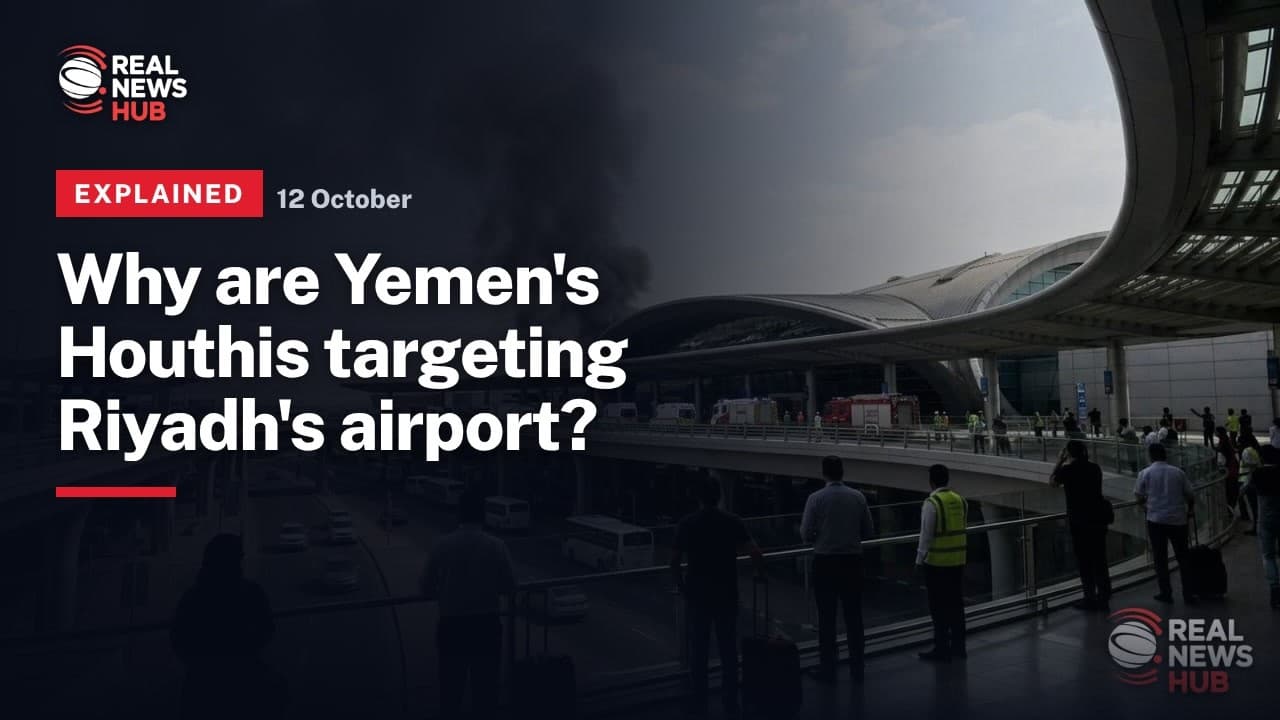
King Khalid International Airport, the main international aviation gateway serving Saudi Arabia's capital, came under repeated missile and drone bombardment over several consecutive days. The most destructive barrage occurred on Saturday, leaving 12 to 13 people dead and more than 300 individuals injured, followed by another projectile strike on Sunday that hit Passenger Hall No 4, sparking a blaze and causing more casualties.
Earlier strikes had already hit the airport on Thursday, killing three Saudi citizens including a commercial pilot, alongside previous assaults on October 6 and 7 targeting facilities in Riyadh and Abha. Aviation authorities suspended all flights into the capital hub, while air traffic tracking services confirmed widespread cancellations, diversions, and regional carrier groundings.
Who carried out the attacks and what are their targets?
Yemen's Iran-aligned Houthi movement claimed responsibility for the operations, stating that it launched ballistic missiles, cruise missiles, and drones against Saudi transport hubs and petroleum facilities. The group asserted that it had also directed munitions at King Fahd International Airport in Dammam and energy assets linked to Aramco, though Saudi authorities did not confirm damage at the oil sites.
Houthi military representative Brig Gen Yahya Saree issued an open warning directing airlines, logistics companies, and passengers to avoid all Saudi civil airports and national airspace. Saree noted that the movement considers every civil aviation hub within the kingdom a potential target, making exceptions only for the holy sites situated in Mecca and Medina.
Why did the conflict reignite?
Houthi representatives stated that the cross-border strikes are direct retaliation for Saudi military backing of the internationally recognized Yemeni government, an enduring economic blockade, and an alleged coalition airstrike on the international airport in Sanaa, which Saudi officials have not acknowledged.
The renewed violence marks the collapse of an informal ceasefire arrangement that had largely held since 2022. Cross-border friction flared again in July when Houthi forces declared an embargo on maritime movements linked to Saudi Arabia and pushed forward along the Red Sea coast near the Bab el-Mandeb Strait, capturing positions including the port of Mokha. A weekend military offensive launched by the Saudi-led alliance to reclaim territory from the rebels prompted rapid escalation, with the Houthis currently governing roughly a quarter of Yemen's territory and 80 percent of its population.
How has the international community responded?
The lethal incidents prompted sharp global criticism. United Nations Secretary-General Antonio Guterres declared that attacks against non-military targets violate international law, while UN special envoy Hans Grundberg warned that the strikes threaten wider peace talks. Regional governments including Qatar, Kuwait, the United Arab Emirates, and Egypt condemned the strikes as violations of Saudi sovereignty.
Because an American citizen was among the deceased, United States President Donald Trump said Washington would evaluate whether to join military countermeasures alongside Saudi forces, promising a swift decision. Foreign governments have adjusted security guidance, with South Korea raising its travel warning to Level 3 and advising its citizens to leave Saudi Arabia, while Western embassies alerted travelers to avoid the airport perimeter.
What are the wider regional consequences?
Beyond the human toll, the attacks have caused widespread disruption to Middle Eastern commercial air travel, prompting precautionary cancellations across several Gulf carriers.
The renewed conflict also threatens broader shipping lanes along the Red Sea and the Bab el-Mandeb corridor, which handle crucial global energy supplies. European Union foreign policy officials indicated they would convene discussions regarding regional tensions, including coordinating European maritime units alongside the Saudi-led naval coalition. Meanwhile, regional security arrangements face tests; Pakistan confirmed its troops stationed in Saudi Arabia are bound by defensive duties under longstanding bilateral and tripartite agreements, but emphasized they will not engage in cross-border ground operations inside Yemen.
Timeline
- 2022An informal ceasefire takes effect in Yemen, temporarily subduing major warfare.
- 2026-07The informal truce breaks down as the Houthis declare a maritime embargo against Saudi Arabia.
- 2026-08Pakistan, Turkey, and Saudi Arabia establish a tripartite defense agreement.
- 2026-09Saudi Crown Prince Mohammed bin Salman asks Washington to launch military action against the Houthis.
- Oct 6, 2026Cross-border strikes hit Saudi aviation facilities, causing fatalities.
- Oct 7, 2026Further strikes hit Saudi airports, leaving three people dead across the two days.
- Oct 8, 2026Houthi strikes hit King Khalid International Airport, killing three Saudi nationals including a commercial pilot.
- Oct 10, 2026A major missile strike on King Khalid International Airport kills 12 to 13 people and injures more than 300; flight operations are halted.
- Oct 11, 2026A fresh projectile strikes Passenger Hall No 4 at the Riyadh airport, injuring more victims as air defenses intercept another incoming missile.
What happens next?
The Saudi-led military coalition has promised a decisive retaliation within the framework of international humanitarian law. The United States government is reviewing whether to participate directly in military actions against the Houthis, while European Union foreign ministers plan to meet to evaluate regional tensions and coordinate maritime deployments. Flight operations at King Khalid International Airport remain halted under precautionary extensions.
This explainer was written with AI assistance from REALNEWS HUB's own reporting listed below, and reviewed before publication. How we use AI
Spotted an error? Report it · Editorial standards · Corrections policy
Sources on REALNEWS HUB
- Saudi capital airport hit by second Houthi strike in two days · Oct 11, 2026 · via World News
- Riyadh airport attacked again after Houthi missile strike that killed 13 and injured hundreds · Oct 11, 2026 · via The National (UAE)
- Foreign ministry recommends S. Koreans in Saudi Arabia leave country amid Houthi attacks · Oct 11, 2026 · via Yonhap
- Major attack on Saudi airport kills 12 and leads Trump to weigh joining fight · Oct 11, 2026 · via NBC News Politics
- Saudi-led coalition vows to ‘respond decisively’ to deadly Riyadh airport attack · Oct 11, 2026 · via The National (UAE)
- Twelve killed in attack on airport in Saudi capital Riyadh · Oct 11, 2026 · via BBC News
- Several injured as Saudi capital airport reportedly hit again · Oct 10, 2026 · via MyJoyOnline Ghana
- Iran's Houthi allies step up deadly attacks on Saudi Arabia · Oct 9, 2026 · via CBS News Politics