

Explained
What is at stake in Israel's parliamentary election?
Israel is voting in its first general election since the October 2023 attacks, pitting Prime Minister Benjamin Netanyahu against former military chief Gadi Eisenkot in a tight contest to build a governing coalition.

Watch: Explained in 3 minutes
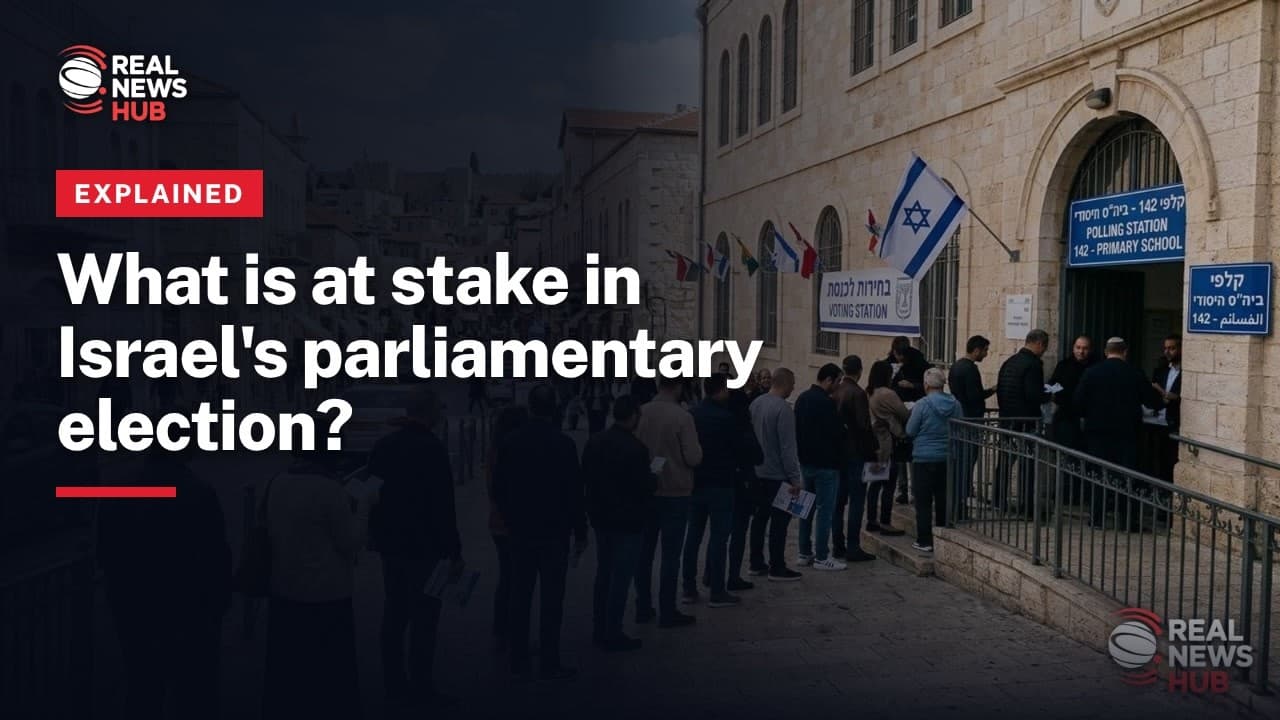
The REALNEWS HUB Explained video · Watch on YouTube
Key facts
- Israel is holding its first nationwide election since the Hamas-led attacks of 7 October 2023.
- Prime Minister Benjamin Netanyahu faces a tight challenge from centrist former army chief Gadi Eisenkot.
- Neither the governing right-wing bloc nor the opposition alliance is projected to hold an outright majority.
- Security concerns, official inquiries into military lapses, and draft exemptions for ultra-Orthodox men lead campaign debates.
- Building a governing coalition requires at least 61 seats in the 120-member Knesset.
Why is this election taking place now?
Israelis are casting ballots in the nation's first parliamentary vote since the 7 October 2023 attacks by Hamas. Those assaults triggered three years of widespread fighting involving Gaza, Lebanon, Syria, Yemen, and Iran.
The election serves as a direct referendum on long-serving Prime Minister Benjamin Netanyahu and his right-wing coalition. Netanyahu is challenged principally by Gadi Eisenkot, a retired military chief of staff who leads the centrist Yashar faction after resigning from the wartime cabinet over disagreements on military policy.
What are the central campaign issues?
National security and responsibility for the intelligence breakdowns of late 2023 dominate campaign debates. Eisenkot has called for an official state judicial commission of inquiry into the 7 October security lapses, an initiative that Netanyahu's government has resisted in favor of a politically balanced panel.
Domestic tensions also center on ending military draft exemptions for ultra-Orthodox men and managing economic pressures, including high living expenses and international sanctions against West Bank settlements. Netanyahu's proposal to use cryptocurrencies to bypass sanctions was rebuffed by the central bank, drawing sharp criticism from rivals who warned against international isolation.
How do the main candidates differ?
Netanyahu has based his re-election bid on the slogan "No Surrender," citing military operations across the Middle East as evidence that his leadership degraded hostile forces. In the closing stages of the race, he warned voters of potential nuclear conflict with Iran, drawing rebukes from Eisenkot for allegedly using security matters for political benefit.
Eisenkot, whose son died during combat in Gaza, presents himself as a unifying outsider who supports an egalitarian, democratic state. He has also pledged to bring an end to Hamas governance in Gaza within eighteen months through diplomatic arrangements backed by Washington or through direct military action.
How is a new government formed?
Under the proportional representation system, a prime minister must assemble a coalition controlling at least 61 of the 120 Knesset seats. Opinion polling prior to the vote showed Netanyahu's Likud and Eisenkot's Yashar running neck-and-neck, with neither alliance holding a straightforward majority.
Netanyahu depends on hardline ultra-nationalist partners, including Itamar Ben Gvir's Jewish Power party. Eisenkot could look to opposition leaders such as Naftali Bennett, Avigdor Lieberman, and Yair Golan. While Arab-led factions like Raam and the Joint List have expressed a readiness to help block Netanyahu, broad Jewish party resistance makes formal coalitions with them unlikely.
What does the vote mean for Palestinians?
Voting has coincided with strict security measures across Palestinian territories. Crossings to the occupied West Bank were ordered closed during the vote, following an attack in Hebron where two soldiers were killed by Palestinian gunmen.
In response, the military enforced an extensive lockdown in Hebron, displacing roughly 2,000 residents. The Palestinian Authority labeled the operation collective punishment, while Netanyahu indicated that broader military interventions could follow. Regarding West Bank administration, Eisenkot rejects the contested E1 expansion plan and suggests local Palestinian autonomy under Israeli defense oversight, though no major Jewish faction currently advocates a sovereign Palestinian state.
Timeline
- Oct 7, 2023Hamas-led attacks trigger regional conflict across the Middle East.
- 2026-03An Iranian strike causes injuries in the southern Israeli municipality of Dimona.
- Oct 23, 2026Two Israeli soldiers are killed at a military post in Hebron, leading to an extensive city lockdown.
- Oct 24, 2026Thousands gather in Tel Aviv to demand a formal inquiry into the October 2023 failures.
- Oct 27, 2026Israelis vote in the national parliamentary election as West Bank border crossings are closed.
What happens next?
Exit polls will be announced after voting concludes on Tuesday evening, followed by official election counts in early November. Israeli President Isaac Herzog will then assign the task of building a viable governing alliance to the party leader seen as most capable of securing 61 seats. If coalition negotiations stall, the deadlock could trigger additional national elections.
This explainer was written with AI assistance from REALNEWS HUB's own reporting listed below, and reviewed before publication. How we use AI
Spotted an error? Report it · Editorial standards · Corrections policy
Sources on REALNEWS HUB
- Israel votes in crucial parliamentary election following regional conflict · Oct 27, 2026 · via World News
- Benjamin Netanyahu urged military action on Iran amid tight election race · Oct 26, 2026 · via Guardian World
- Israel election sets up tight contest between Netanyahu and Eisenkot · Oct 26, 2026 · via BBC News
- Israel heads to close national election following years of regional war · Oct 25, 2026 · via BBC News
- West Bank crossings to shut as Israel enforces Hebron lockdown ahead of vote · Oct 25, 2026 · via Aljazeera English
- Benjamin Netanyahu faces battle for wavering voters in traditional strongholds · Oct 25, 2026 · via Al-Monitor
- Tel Aviv demonstrators protest against Netanyahu ahead of general election · Oct 24, 2026 · via Al-Monitor
- Arab-Israeli parties signal openness to opposition pact against Netanyahu · Oct 24, 2026 · via Al-Monitor